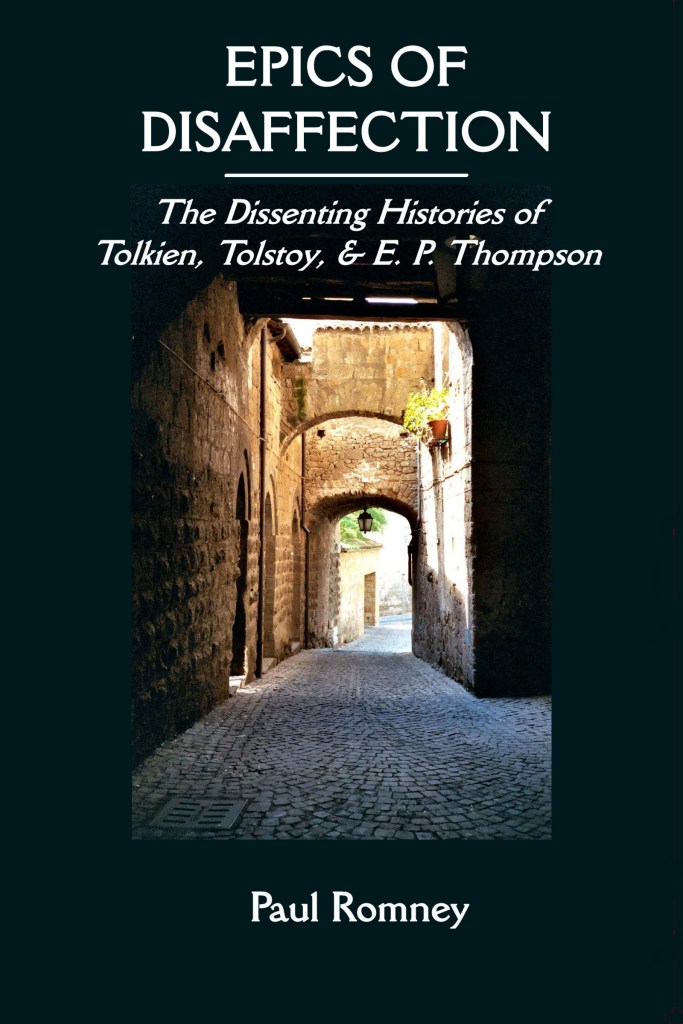
EPICS OF DISAFFECTION: THE DISSENTING HISTORIES OF TOLKIEN, TOLSTOY AND E. P. THOMPSON is an essay on the epic imagination as expressed in four narratives of different genres, each of which underwent an epic transformation in the course of composition. Each recounts a grand conflict with a scope and imaginative completeness that exhibits human experience in the light, not just of history, but of eternity. I call them epics of disaffection, and dissenting histories, because I contend that the metamorphosis was driven by an urge to prophesy arising from the authors’ alienation from modernity, which I relate to their experience of front-line combat.
Epics of Disaffection (paperback ISBN 979-8-218-02223-5) is available through AbeBooks, Amazon, Barnes & Noble, and your bookstore. An ebook (ISBN 979-8-218-02222-8) is also available.
EPICS OF DISAFFECTION
“There is little or no Christian consolation on offer in any of the stories discussed here — even Tolkien dispenses, rather, the consolation of imagining a world in which individuals can make a difference. I might call that escapist were it not also true of War and Peace and The Making of the English Working Class.
“Often the prophetic voice cries for a return to ancient values, or what it figures as such. Finding enduring value in the past, Tolkien, Tolstoy and Thompson all assert the continuity of past and present against a modernity which they perceive as turning its back on the past, and they celebrate nature and community above all else.
“In evoking the numinous for a secular audience … it is vital to the suspension of disbelief that God does not leak into the narrative. Curiously enough, my three writers all found ways of ensuring this that reflect Forster’s distinction between prophecy and fantasy. Forster assigns the former to the upper air and the latter to the lower air. Our four prophetic histories, the fictional ones in particular, show a distinct tendency to bring the celestial down to earth by transposing its manifestations from the upper to the lower air.
“Tales of a dystopian world that has already undergone catastrophe can at best tell of private resistance to triumphant evil, as offered by Connie and Mellors in Lawrence’s novel or Winston and Julia in Orwell’s. The four narratives discussed here offer something else: a heroic story of collective resistance to evil insurgent but not yet triumphant.
THE LORD OF THE RINGS
“The features of the Wild which are peculiar to The Lord of the Rings — its baleful historicity and propensity to encroach — lend themselves to an analysis of the relationship between past and present in terms of the past impinging on the present. The fact that the confrontation begins and ends in the Shire fits that pattern. But Tolkien’s story is not mainly about the invasion and occupation of the Shire — the story’s fantasy-present — by an encroaching past; it is about a journey into the past as represented by the historicized Wild. In other words, Frodo’s journey into the Wild is a journey into history. What is on its face a journey over land becomes the journey in time that Tolkien had first attempted in “The Lost Road.”
“Frodo’s journey in time expresses an ingenious narrative strategy that is clearly designed to achieve what Tolkien had first attempted in “The Lost Road.” In that story, however, time functions as a dimension, across or through which one can travel from point to point. In The Lord of the Rings it is more like a medium. Tolkien’s hobbit heroes venture into the past as one might wade into the sea, suddenly start bobbing in the waves, and then be lifted off one’s feet — and in this case swept away by a rip-current. As they follow the path that will bring their “suburban” world into conjunction with that of Tolkien’s legendarium, the story progressively becomes saturated with history and their eyes are relentlessly opened to that history …
“Tolkien was a subtle and exact thinker, but he was also a very feeling man. Thinking apprised him of the limits of reason, and feeling imbued him with a need for knowledge beyond reason; hence his ultimate criterion of truth was intuitive rather than intellectual. Deepest truth was to be found in stories whose authenticity was affirmed by their broad acceptance across cultures and across time, stories expressing a truth that was informed by reason though not apprehensible by it. This idea, of truth that is accessible to intuition but not to reason, is the underlying theme — the ground bass — of The Lord of the Rings.
“Yearning for consolation, Tolkien reached back towards the Beginning, and his yearning found expression in his legendarium. First in “The Lost Road”, and then in The Lord of the Rings, he attempted to build a bridge between the pre-history of his legendarium and the present.
WAR AND PEACE
“During the war, Tolstoy spent nearly a year as an artillery officer in the garrison of the besieged port of Sevastopol. Amid the fighting, he began to publish semi-fictional “sketches” of the siege. The first, full of patriotic idealism, won the new tsar’s approval; the second, reflecting the horror and disillusionment of six months of battle, was mutilated by the censor and earned the disapproving attention of the police. Tolstoy emerged with respect for the rank-and-file soldier and a lasting hatred of war and scorn for bureaucracy, both civil and military.
“The quest romance is a sort of epiphenomenon, inseparable from the story as a whole — much as, in The Lord of the Rings, the time-travel aspect only appears in relation to the overland journey. It is so embedded in Tolstoy’s realist novel that we can only get at it by pinpointing the places where the narrative hints at something that is not “real,” and it is achieved by the very narrative techniques of implication and indirection that he uses to capture so much of the “real” world in so comparatively small a span.
“Tolstoy is no less a trickster than Dolokhov, and here his trickery goes beyond simply setting up a trite situation and subverting the expectations it arouses. Dolokhov is one of two characters that he develops by defeating the expectations engendered by his own narrative style: that is, by using his normal tone to convey information that is either false or seriously misleading.
“His insertion of fairyland is sparing yet systematic. Riding home from Uncle’s through the dark, damp night, Natasha fantasizes that she and Nikolai might find that they have arrived not at Otradnoye but in fairyland. She feels that she will never be as happy and tranquil as she is now, and Nikolai feels that he would be happy to drive like this with her for ever. But fairyland can mark mortal visitors in ways that do not serve them well in the “real” world, and both of Natasha’s brothers visit it to their cost.
“We can think of the Rostov domain as a sort of barebones Middle-earth, with the Rostovs doubling as hobbits and elves and fairyland supplying the barest hint of other worlds beyond the edge of rational knowing. A barebones Middle-earth is all Tolstoy needs, because for him, unlike Tolkien, the quest romance is not the main point of the exercise but simply a way to symbolize the political concerns that inspired him in the first place.
THE MAKING OF THE ENGLISH WORKING CLASS
“The epic treats history in ways that sit uneasily with the canons of academic history. The epic has heroes and villains; it takes sides; it idealizes; it presents archetypal characters in exemplary situations. It also imagines worlds beyond that of everyday experience — even Tolstoy subtly modulates his hard-edged realism to hint at fairyland. But academic history must surely be even more tightly bound to reality than the most earnestly realist fiction. If, then, as Tillyard says, the epic is marked by a breadth of vision that spans the gamut from the simplest sensualities to a sense of the numinous, where shall we seek the numinous in an empirical work of historical discovery? If, as Frye says, the site of epic action is typically a middle ground between the upper and lower gods, where are we to find the gods?
“The paradigm is Paradise Lost. Milton’s poem is almost an anti-epic, in which the author expressly mocks the traditional subject-matter of the epic and assigns the conventional heroic role to an anti-hero, Satan. But a story of the beginning of human history must also be a story of the beginning of human heroism, for who needed heroism in Eden? Heroism begins at the end of Paradise Lost, when Adam and Eve, newly apprised of their mortality and the suffering it must entail, “hand in hand with wandring steps and slow,” embark on their long exile. But “When Adam delv’d and Eve span / Who was then the gentleman?” The heroism of Adam and Eve is not, Milton tells us, the valour of “fabled Knights / In Battels feignd” but “the better fortitude / Of Patience and Heroic Martyrdom / Unsung.” Like Tolstoy and Tolkien, Thompson sings the heroism of Everyman.
“A saga of heroic resistance to evil, with a cast of thousands; the tale of a turning-point in history, set against the backdrop of a world destroyed — a lost past, partly mythic, linked to a future which is, ultimately, the reader’s own time. These are some of the features that mark The Making as epic. But where are the gods? Where can they be? Even War and Peace gives us little more by way of the numinous than a fairyland of the mind and a sky that is a source of ambiguous revelation. But that doesn’t matter: we are not looking for stock literary tropes belonging to an essentially pre-modern genre. We are looking for the source of an effect — one that marks off Thompson’s story from the common run of modern narrative histories by imbuing it with a hint of the numinous.
“Ned Ludd and Robin Hood: such allusions make Thompson’s beleaguered craftsmen the functional equivalent of Tolkien’s elves, Tolstoy’s Rostovs and Walter Scott’s MacIvors: it invests them with doomed glamour. As we saw with War and Peace, a realist narrative needs only a barebones Middle-earth to evoke the numinous, and like the Rostovs, Thompson’s doomed artisans can stand in for both hobbits and elves. But the reference to a lost constitution brings up the second aspect of the narrative’s temporal positioning. The lost world is not just a world of relative ease and plenty. More explicitly than Tolstoy’s epic zone, it is a political Eden, too. The story of the making of the English working class does not just slot into the Marxist narrative embracing the whole of human history. It also fits into the story of the Free-born Englishman, with its own mythology reaching back past Anglo-Saxon times to an original constitution which must, thought the silversmith John Baxter, have been free. Without endorsing the myth, Thompson allows it to colour his narrative and weaves it into a tale that continues in our own day, thereby producing a romantic intensity and a glint of the numinous that could remind readers of The Lord of the Rings and Moby Dick.
THE SYKAOS PAPERS
“Thompson’s satirical intent makes The Sykaos Papers a very different sort of fantasy from The Lord of the Rings, but less different than one might suppose.
“Like The Lord of the Rings … The Sykaos Papers is a fantasy written by a scholar; and like Tolkien, Thompson applies his expertise to the invention of faux-scholarly texts as a means of realizing his imaginary universe.
“From this grafting of the apocalyptic onto the satirical, the idyllic emerges. As in War and Peace and The Lord of the Rings, its setting is a refuge beset by evil; and as in Tolstoy’s story, its idyllic essence is at first obscure — and for the same reason. As with the Rostov domain, the evil that besets Thompson’s Zone of Eden is banal, mundane and rendered satirically, making a careful, gradual transition to the idyllic essential.
“A preternaturally handsome poet, gorgeously robed, whose people dwell in communities insulated from the intractable realities of physical decay; an androgynously (at first) charismatic aesthete possessed of superhuman attributes; on Middle-earth but not of it; a keen-eyed commentator on the follies and foibles of the mortals who fondly think the Shire is theirs for ever — surely Oi Paz is an elf. He even, like Tolkien’s elves, speaks a language of his own … And like Tolkien’s elves, Oi Paz gives voice to the vast cosmic context in both space and time.
“Thompson’s story sets the end of human history in a version of universal history that is geophysical rather than eschatological. It presents the whole of human history as a fleeting moment in the history not only of Sykaos but of Oitar, and it presents the geophysical history of both planets as fleeting moments in the history of the universe. Oitar’s encounter with the Sykaans is framed in Oitarian myth and history, and that narrative is dominated by the geophysical evolution of their planet and solar system, which is framed in the larger story of the evolution of the universe as a whole. Yet Thompson’s epic vision is also evocative of Moby Dick. Viewed from outer space, what is Sykaos but another Pequod, a ship of fools doomed by human (indeed, American) hubris?
 Paul Romney